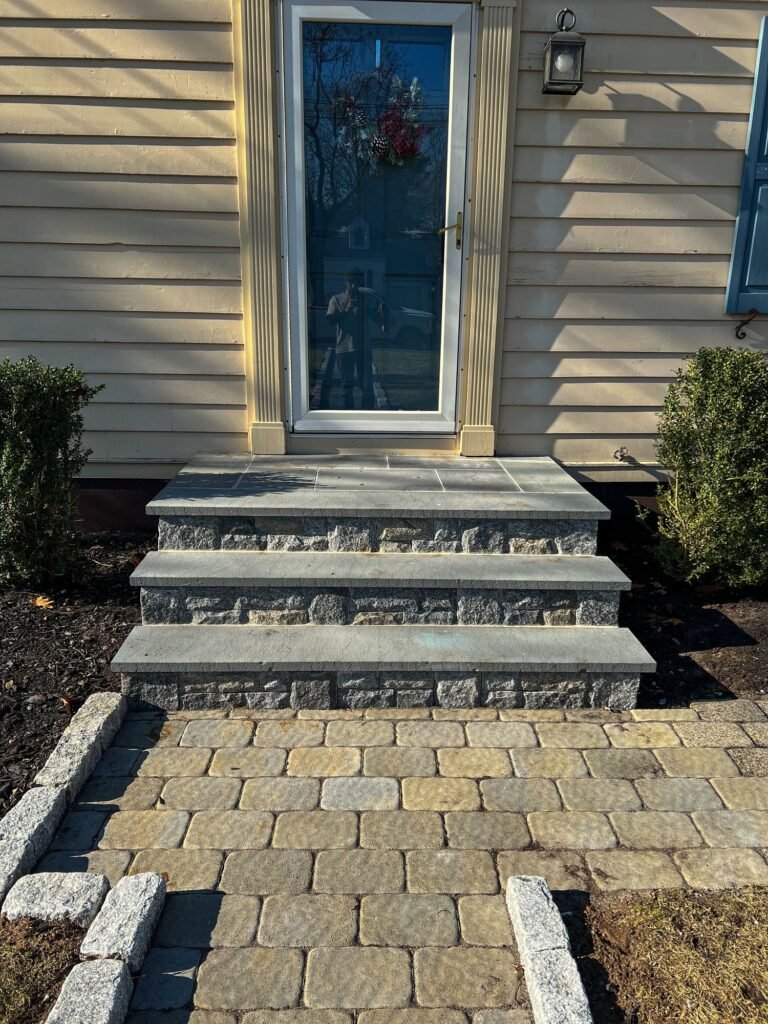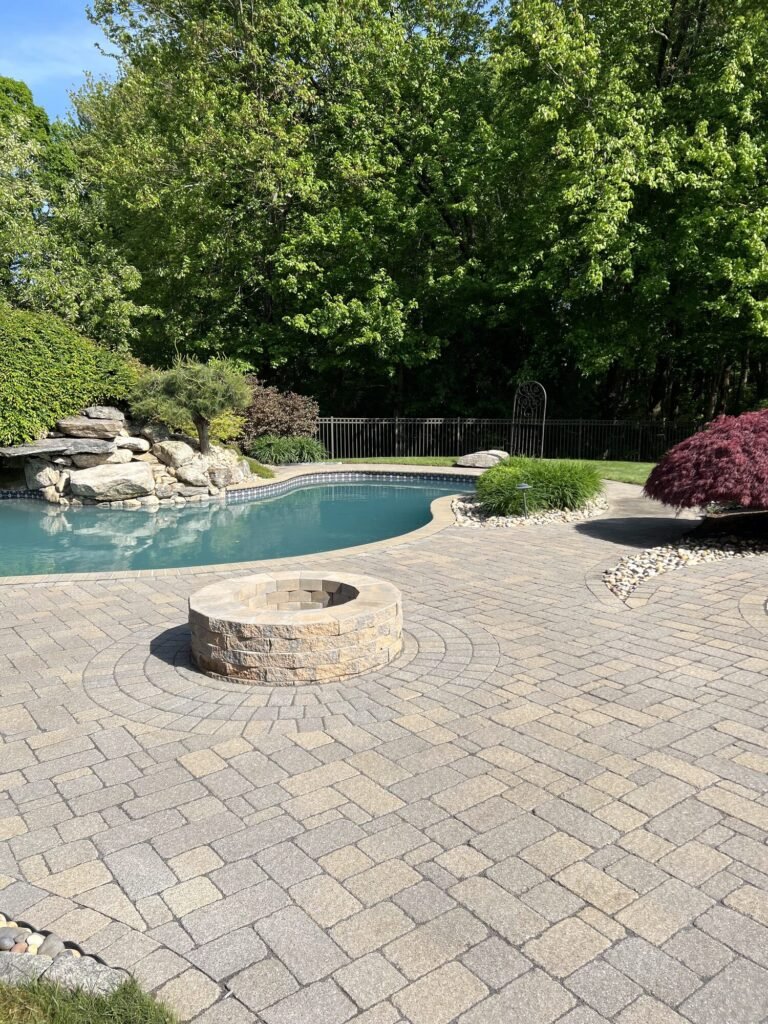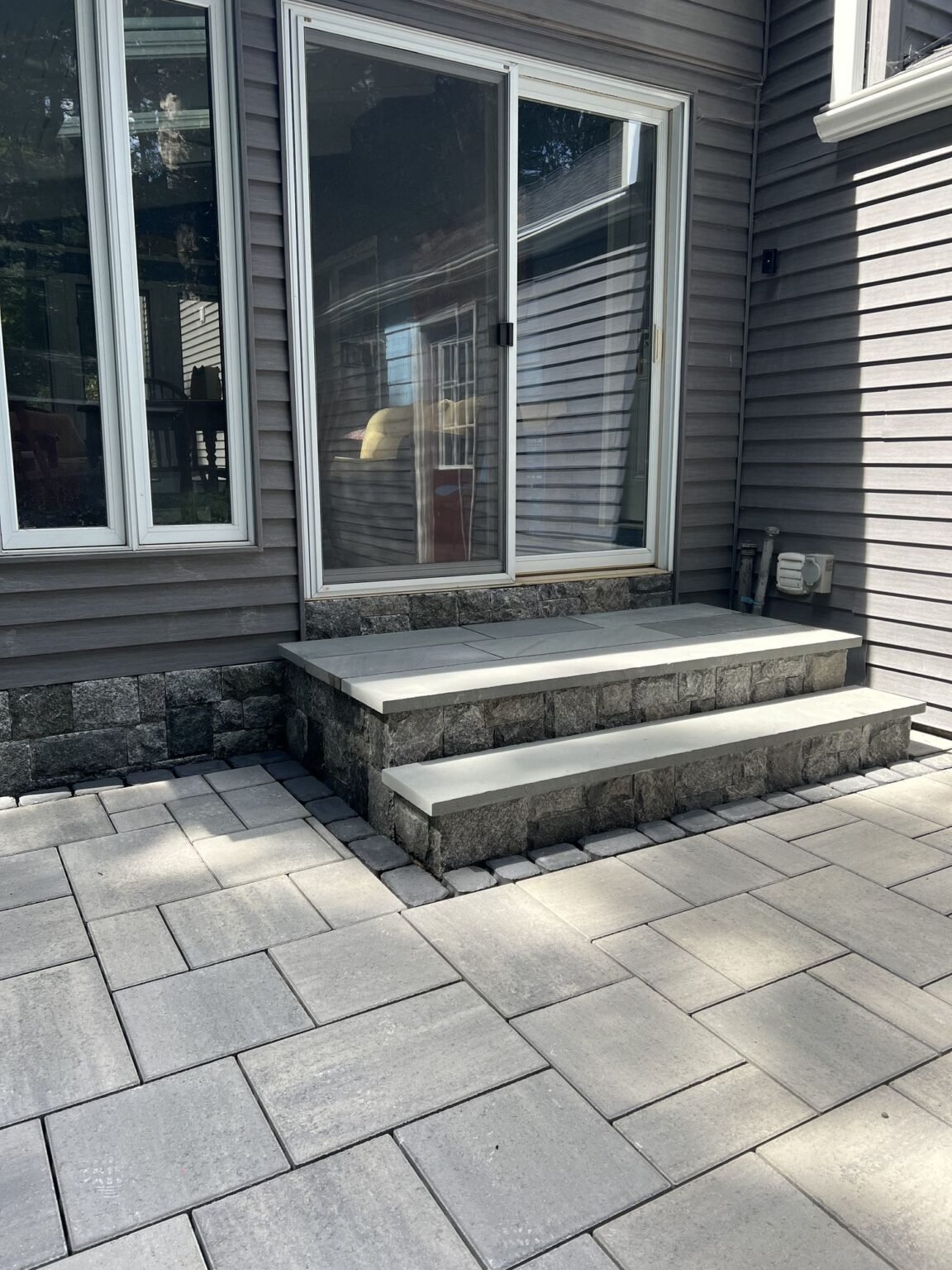
Bluestone and concrete pavers are the two materials we’re asked about most for patios, walkways and steps. Both can look great and both can last. They get there in different ways, and the right choice depends on your house, your budget and how much variation you like in a finished surface.
What bluestone is
Bluestone is a natural sandstone quarried in the Northeast, mainly in Pennsylvania and New York. It’s a regional stone, which is part of why it looks at home on Connecticut houses. Colors run from blue-gray to blue-tan.
It’s sold with two main surfaces:
- Natural cleft: split along the stone’s natural layers, with a textured, slightly uneven face.
- Thermal: heat-finished for a flatter, more uniform surface, common for treads, caps and formal patios.
It comes as cut rectangles and squares in a range of sizes, or as irregular flagstone.
What concrete pavers are
Concrete pavers are manufactured to a standard. ASTM C936, the specification for solid concrete interlocking paving units, requires an average compressive strength of at least 8,000 psi, average water absorption no higher than 5 percent and a minimum thickness of 60 mm, with freeze-thaw testing for units that will see freezing weather and deicing salts.
Brands like Techo-Bloc, Unilock and Cambridge make pavers and slabs in many shapes, colors and textures, including slabs designed to look like natural stone. Techo-Bloc’s Aberdeen slab, for example, has a slate texture and a bluestone-like look in sizes up to 30 by 30 inches.
How they compare
| Bluestone | Concrete pavers and slabs | |
|---|---|---|
| Look | Natural stone with real variation in color and texture | Consistent color and size; many styles, including stone-look slabs |
| Strength | Natural material; quality varies by quarry and thickness | Made to ASTM C936 (8,000 psi average, 5% maximum absorption) |
| Installation | Dry-laid on a gravel base or mortar-set on a concrete slab | Dry-laid on a compacted gravel base with polymeric sand joints |
| Repairs | Individual stones can be reset or replaced; matching can be harder | Individual units can be lifted and reset; matching is easier |
| Warranty | Depends on the supplier | Techo-Bloc offers a transferable lifetime warranty on residential products |
| Cost | Usually costs more than concrete pavers | Usually costs less than natural bluestone |
How each handles a Connecticut winter
Both can handle freeze-thaw when they’re installed on a proper base that drains. The base matters more than the material. A flagstone patio set on stone dust with no real base will heave just like a poorly built paver patio. See why base preparation matters for what goes underneath.
On deicing salt, Techo-Bloc states that sodium chloride and calcium chloride won’t harm its standard paving stones, and its residential warranty covers surface deterioration caused by rock salt (excluding its wet-cast Stonedge line). With natural stone, ask your stone supplier how that particular stone handles salt, and use salt sparingly.
Heat and comfort
Darker surfaces get hot in full sun, whether natural or manufactured. Blue bluestone and charcoal pavers both warm up more than light colors. Around a pool or anywhere you walk barefoot, lighter colors are more comfortable, and a textured finish gives better grip when wet.
Maintenance
Bluestone needs little beyond occasional cleaning. Paver patios benefit from keeping the joints full of sand, and sealing is optional. Techo-Bloc recommends waiting at least a year before sealing new pavers and resealing every three to five years if you choose to seal. Our paver maintenance guide covers what’s involved.
Which should you choose?
Bluestone is a good fit if you want natural stone, a traditional New England look, or steps and treads that suit an older house. Concrete pavers and slabs are a good fit if you want a wider choice of colors and textures, consistent sizing, a manufacturer’s lifetime warranty and a lower price per square foot.
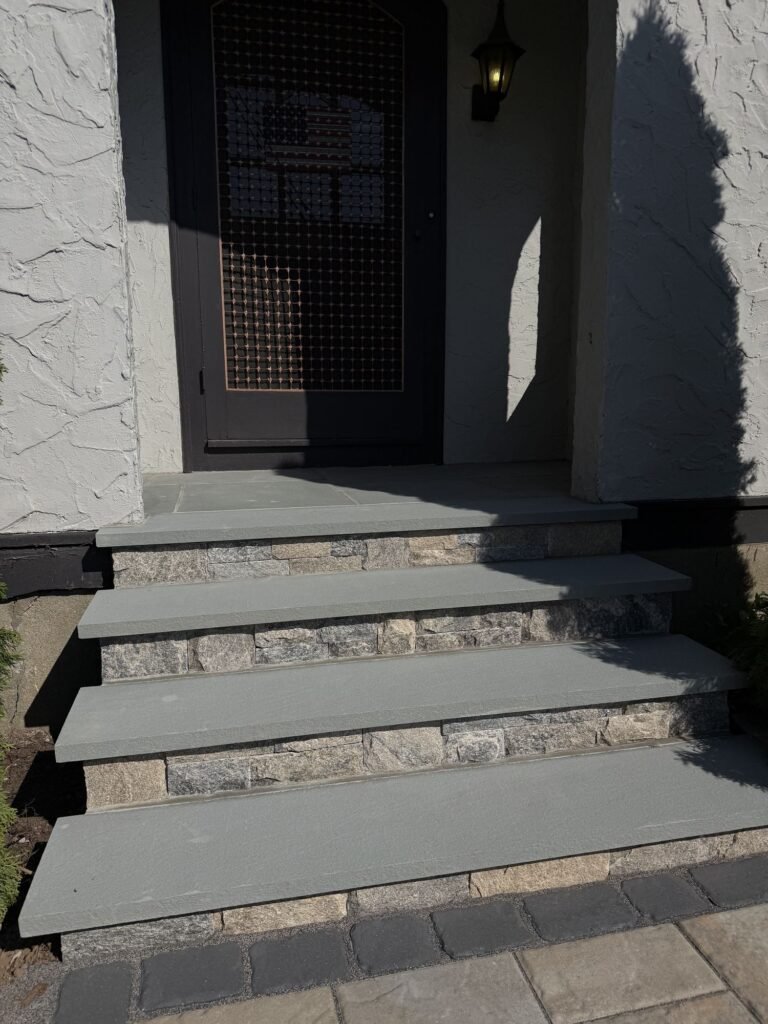
You don’t have to choose just one. Some of our favorite projects combine them: a paver patio with bluestone steps, or a paver walkway that meets bluestone treads at the front door.
What a paver patio costs
Most paver patios we build run about $25 to $35 per square foot installed. Natural bluestone is priced separately because stone size, thickness and finish vary so much, and we quote it once we’ve seen the project. Our patio cost guide shows typical prices by size.
Want to see both side by side? We bring bluestone and paver samples to every estimate and show your project in 3D. See our stone veneer and bluestone and paver patio pages.
Common questions
Is bluestone slippery when wet?
Thermal-finished bluestone is smoother than natural cleft, so it can feel slicker. Natural cleft has more texture. For pool areas, a textured finish in either material is the safer choice.
Do concrete pavers fade?
Techo-Bloc’s standard pavers are pigmented all the way through, so the color doesn’t wear off the surface. Its wet-cast Stonedge products are made differently.
Can you mix bluestone and pavers?
Yes. Bluestone steps, treads or borders with a paver field is a common and good-looking combination.