Stone veneer gives front steps, foundations, retaining walls and pillars the look of solid stone without the weight of full-thickness masonry. It comes in two kinds: natural thin stone, which is real quarried stone sawn thin, and manufactured stone, which is concrete cast and colored to look like stone. On day one they can look alike. They differ in weight, color, how they age and what they cost.
Here is how the two compare, and what matters most on a Connecticut home.
Natural vs. manufactured stone veneer at a glance
| Natural thin stone veneer | Manufactured stone veneer | |
|---|---|---|
| What it is | Real stone (granite, fieldstone, limestone and others) sawn to a thin profile | Concrete with lightweight aggregate and mineral oxide pigments, cast in molds |
| Thickness | About ¾” to 1½” | At least ¼”, averaging no more than 2⅝” under ASTM C1670 |
| Weight | About 8 to 15 lb per sq ft installed | No more than 15 lb per sq ft under ASTM C1670 |
| Color | The stone’s own mineral color | Pigment added to the concrete |
| Look | No two pieces alike | Molded shapes that can repeat across a wall |
| Material cost | Higher | Lower |
What natural thin stone veneer is
Natural thin veneer is quarried stone or fieldstone sawn to about ¾” to 1½” thick. Installed, it weighs roughly 8 to 15 pounds per square foot, about a quarter of full-bed stone, so it can be adhered to a wall instead of needing its own footing or ledge.
Because it is real stone, the color and texture run through each piece, so a chip or a fresh cut shows more of the same stone. Most natural veneer lines include matching corner pieces, so outside corners read as solid stone.
What manufactured stone veneer is
Manufactured stone veneer is a concrete product: cement and lightweight aggregate, colored with mineral oxide pigments and cast in molds. It is covered by ASTM C1670, which sets minimums for compressive strength (an average of at least 2,100 psi), bond strength (at least 50 psi), freeze-thaw testing and size, and caps units at 15 pounds per square foot. Installation methods have their own standard, ASTM C1780.
Its color comes from pigment in the concrete rather than from the stone itself. This Old House notes that manufactured veneer can be more prone to chipping or cracking than natural stone, though newer products have improved.
Connecticut winters: installation matters more than the stone
Both types are adhered veneer: set in mortar over metal lath and a scratch coat, or directly on prepared masonry. That assembly absorbs and holds water, so the details behind the stone decide whether a wall stays dry through freeze-thaw winters.
For adhered veneer on wood-framed walls, the residential code calls for:
- a weep screed at the base of the wall, so water can drain out, with at least a 3½” attachment flange
- at least 4″ of clearance above soil, 2″ above paved areas and ½” above walking surfaces on the same foundation
- flashing where a roof meets a sidewall, so runoff is kicked away from the veneer
The Masonry Veneer Manufacturers Association recommends two layers of water-resistive barrier behind the lath. With only one layer, the scratch coat can bond to it and stop it from draining, and Penn State’s residential building research center points to this as a cause of moisture problems behind manufactured stone.
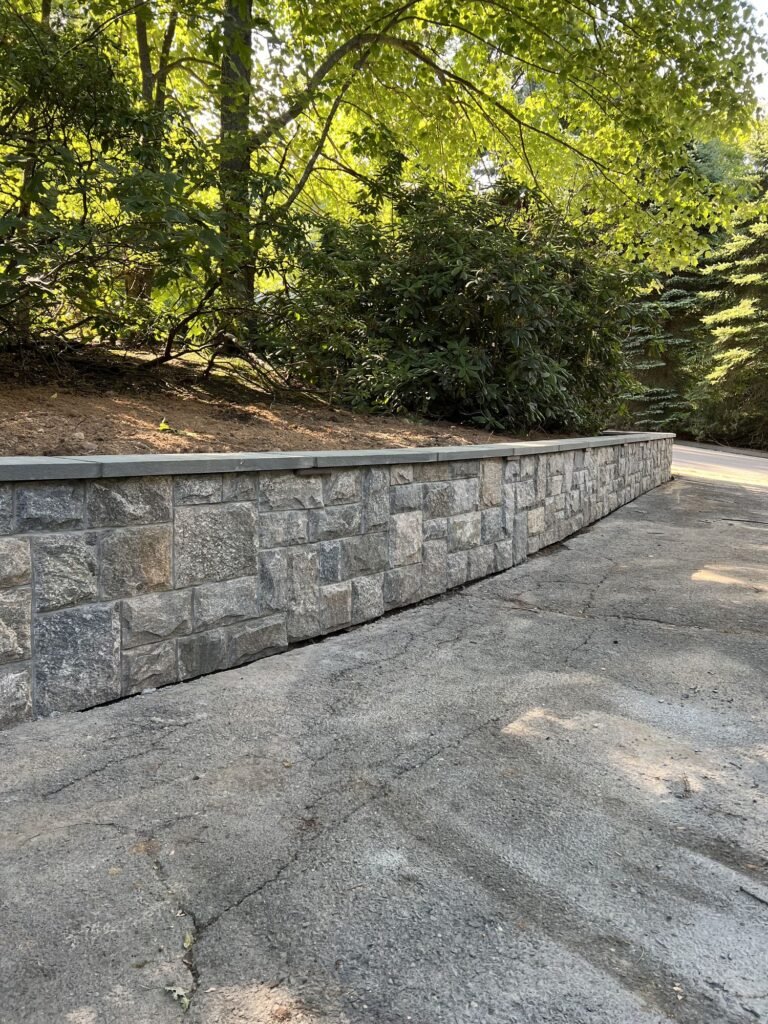
Steps, foundations and retaining walls
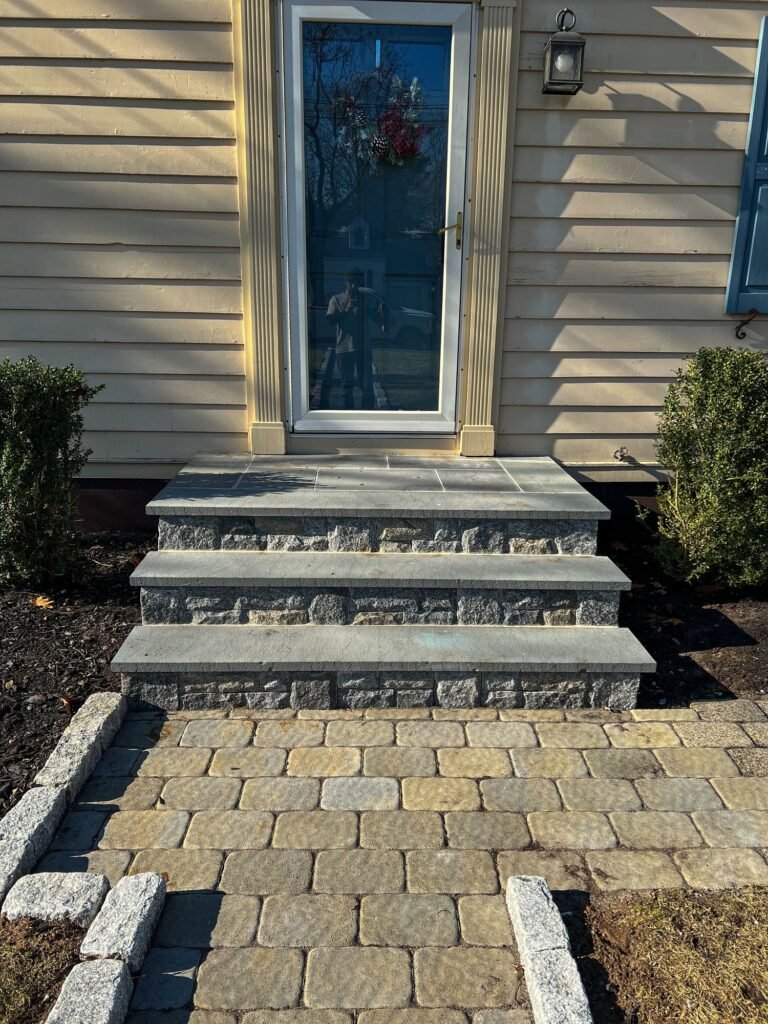
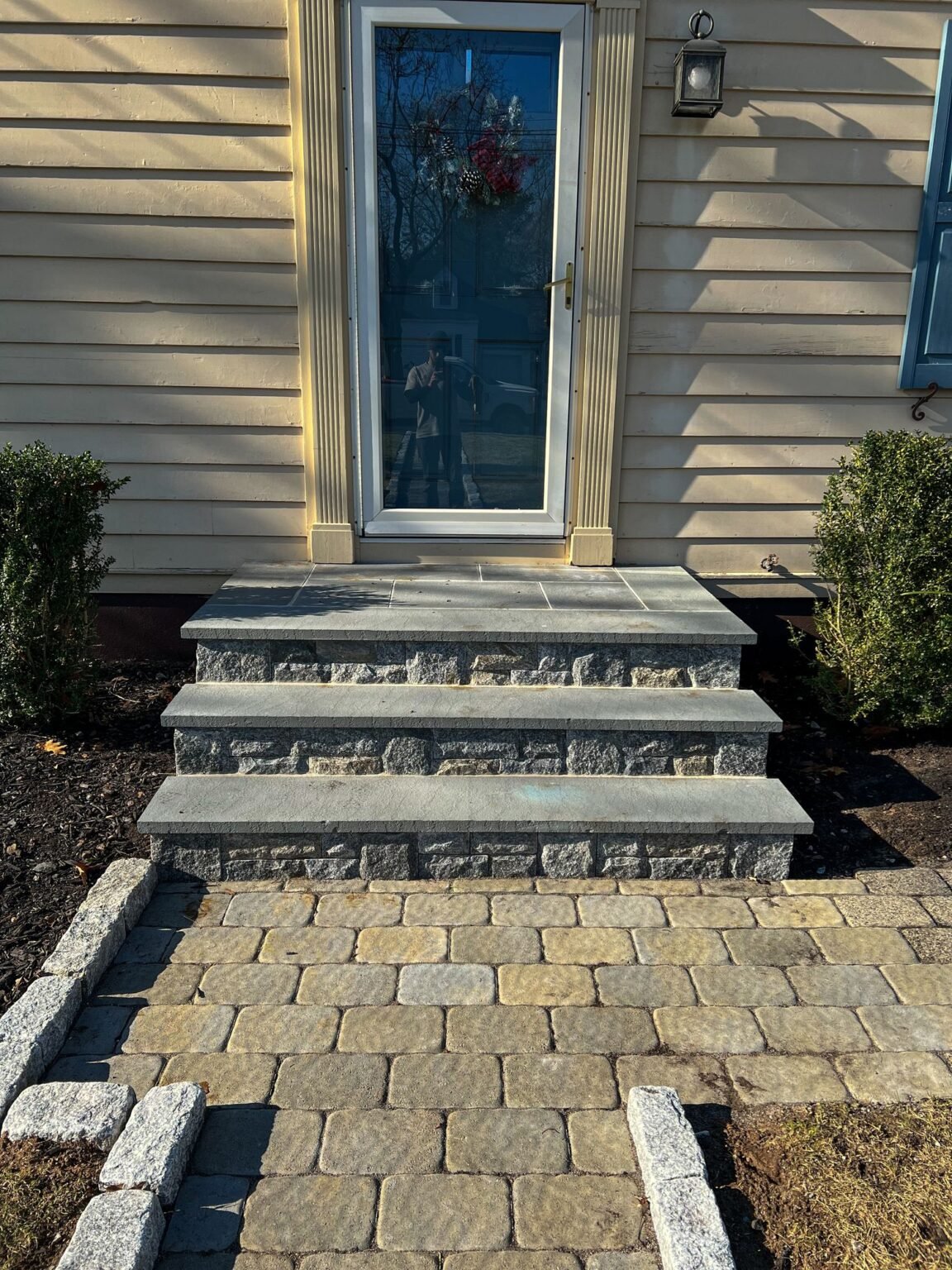
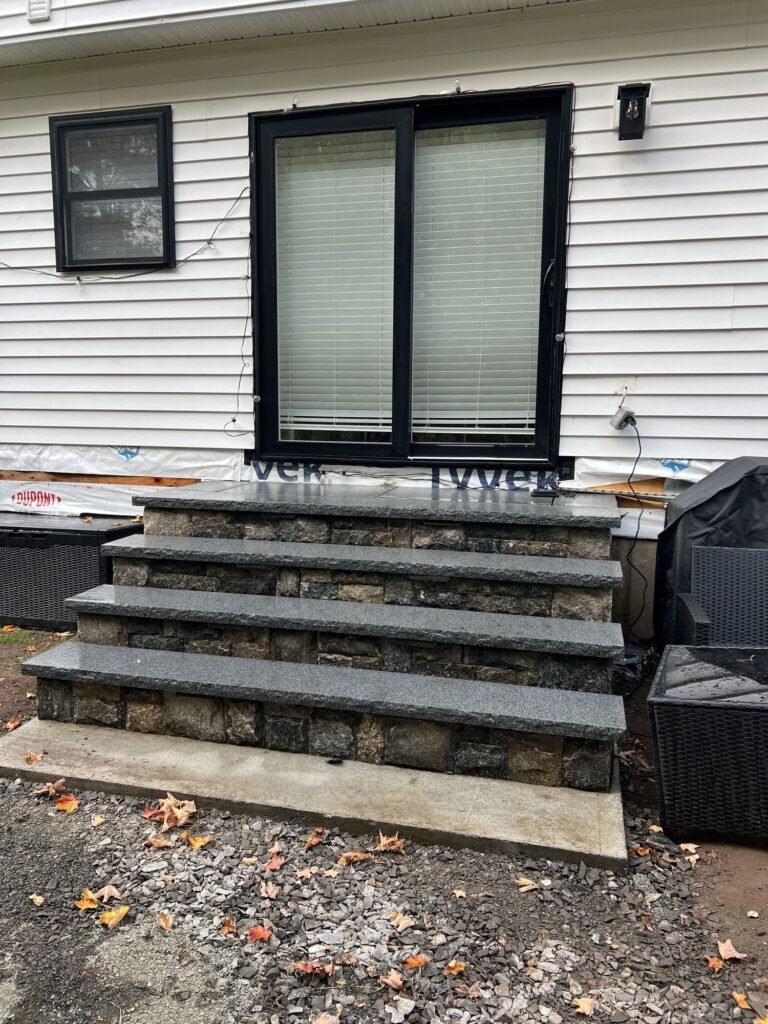
Much of our veneer work is on masonry rather than framed walls: step risers, foundations, pillars and the face of retaining walls. Over sound concrete or block, what matters most is a solid substrate, full mortar coverage behind every stone, and caps or treads that shed water off the face instead of into it.
Near driveways and walks, plow spray and deicing salt reach the lower courses. Makers of manufactured stone caution that deicing salt and harsh cleaners can stain or discolor it, which is one reason we favor natural stone close to grade.
What each costs
Natural stone costs more. This Old House, citing Angi contractor data, lists natural veneer at about $11 to $18 per square foot and manufactured veneer at $5 to $8, with installation adding roughly $2 to $4 per square foot for either. Those are national averages. On a real project, the number of corners, cuts and the condition of the wall behind the stone affect the price as well.
We price veneer work after seeing the steps or wall in person, and the quote spells out the stone, corners and prep separately.
Which one should you choose?
Natural thin stone is usually the better fit when:
- the veneer sits close to grade, on steps or beside a driveway that sees salt and plow spray
- you want real stone whose color stays the same when it’s chipped or cut
- it needs to match bluestone treads, caps or natural stone already on the property
Manufactured stone can make sense when:
- budget is the main driver and the wall is protected from splash and salt
- you want a very even color, or a stone style you can’t get locally
Either way, the installation details above matter as much as the material.
Frequently asked questions
Is stone veneer real stone?
Natural thin stone veneer is real stone sawn thin. Manufactured stone veneer is concrete made to look like stone. Both get called “stone veneer,” so ask which one a quote includes.
Can you put stone veneer on concrete steps?
Yes, if the concrete is sound. Steps that have settled, cracked through or pulled away from the house need to be rebuilt first. Our repair or replace front steps guide covers how to tell.
Does manufactured stone fade?
Its color comes from pigment in the concrete. Manufacturers warn that chlorinated pool water, deicing salt and harsh cleaners can discolor it, so follow the maker’s care instructions.
How long does stone veneer last?
Installation decides most of it. Veneer with proper drainage, clearances and flashing stays dry behind the stone; veneer over a single layer of building paper, or buried in soil or mulch, is where problems usually start.
Planning a stone veneer project?
We install natural stone veneer on front steps, foundations, retaining walls and pillars, often paired with bluestone treads and caps. See our stone veneer and bluestone work, or our front steps and retaining walls pages. For flat surfaces, our bluestone vs. concrete pavers guide compares the two most common patio materials.